
Cuneiform Clay Tablet Challenge
Big Idea:
People in ancient Sumer invented one of the world's earliest writing systems. Instead of writing on paper, they pressed wedge-shaped symbols into soft clay to record information, tell stories, and keep track of important events.
Materials:
- Play-dough, modeling clay, or air-dry clay
- Wooden craft stick, pencil without the eraser, chopstick, or popsicle stick to use as a stylus
- Paper and pencil for planning
What to Do:
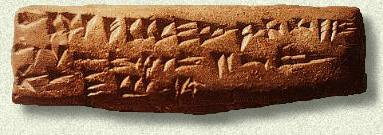
Chaos, Public domain, via Wikimedia Commons

AnonMoos, Public domain, via Wikimedia Commons
Step 1: Explore Ancient Writing
Show your learner a picture of real cuneiform writing. Notice that the symbols are made from small wedge-shaped marks rather than letters. Explain that each symbol represented sounds, words, or ideas.
Step 2: Make a Clay Tablet
Flatten a ball of clay into a smooth rectangle or oval, just like a small tablet. Ancient Sumerians used wet clay because it was easy to write on and plentiful near the rivers.
Step 3: Press Your Message
Use the stylus to press symbols into the clay instead of drawing lines. Younger learners can invent their own symbols or copy a few simple cuneiform signs. Older learners can try writing their name or recording something simple like "5 sheep" using pictures and symbols.
Step 4: Read and Compare
Let family members guess what the tablet says before the creator explains it. Compare everyone's symbols. Were some easier to understand than others? Discuss why people eventually developed shared writing systems.
What's Really Happening (Caregiver Explanation):
Cuneiform was one of the earliest known writing systems, developed in ancient Sumer over 5,000 years ago. Instead of using an alphabet, writers pressed wedge-shaped marks into soft clay using a reed stylus. Writing began as a way to keep track of goods such as grain and animals, but over time it was also used for laws, letters, stories, and history. Thousands of clay tablets have survived because the clay hardened over time, giving historians a remarkable window into one of the world's earliest civilizations.
Digging Deeper:
Look at photographs of real cuneiform tablets and compare them with your child's work. Ask why clay may have been a better choice than paper in ancient Mesopotamia. Older learners can investigate how writing changed over thousands of years (from cuneiform to alphabets) and discuss why writing became one of humanity's most important inventions.